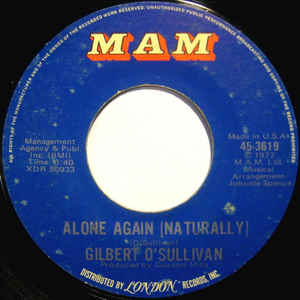
Alone Again (Naturally)

11 Jul

alone-again

Cigarettes and beer on a warm summer breeze. 

To this day, walking the streets of New York, I’ll turn a corner and bam!  There it will be: that essence of summer 1972.  And I have to stop, because, for a moment, I am nine years old, sitting on the porch of our Lake Michigan cottage, holding my little Sears & Roebuck 9 volt transistor radio, listening to Gilbert O’Sullivan’s “Alone Again, Naturally.”

It’s an odd song for a kid to fall in love with.  A father dies, a mother dies, a young man’s abandoned at the altar.  I believe suicide may be contemplated.  But none of this really matters.  Because it’s not the words so much as the gently loping beat, like the saunter of a sun-kissed girl walking along the sand, a melody with the quiet insistence of waves on a shore,  and that distinctly English melancholy of something beautiful coming to an end.

Cigarettes and beer.

It was a crazy summer.  My cousin Joni, sixteen and wild, had run away to California, only to turn up several weeks later, with a copy of Joni Mitchell’s Blue tucked beneath her newly unshaven armpits.  She would play “California” and then solemnly intone to whoever would listen, “It was just like that.”  She was so cool.

But even cooler was her friend Memphis.

First of all she was from Memphis.  Second of all she would take driftwood  and turn it into art, painting it with a big letter “M”, and clouds, and seagulls and stuff.

But mostly, she would talk to me.

We’d sit on the porch as the sun went down and the beachgoers across the street packed up for the day, and in her exotic southern accent she’d tell me stories.  Like how her sister had been home sick one time when she heard that her boyfriend, whose Camaro Z28 was the baddest car in all of Memphis, was stepping out on her.  How her sister had pulled on her bathrobe, tied a scarf over her rollers, and headed out in search of that Z28, and how, finding it parked outside a local burger joint, she had stopped the car, walked inside, and dropped her boyfriend’s date with a single punch.

And we would talk about girls.  She tried to get me to believe that the prettiest weren’t always the nicest, and that I should always give the less attractive girls a chance.  I didn’t really believe her, but I lied and told her that I had a crush on a girl who wasn’t very pretty at all.  She smiled.

And as the night settled in, and the rangers locked the gates and began their patrols, we watched the spotlight on their pickup sweep across the darkness, while the adults inside the cottage gathered around the big table, talking and laughing, playing cards.  The breeze lifted the hair from Memphis’ face and I stole a glance as she looked out across the water.  It was 80 miles to Milwaukee.  Too far to see.


Heath came to me last night as we were getting ready for bed.  Having mistakenly tried to eat ice cream from a frozen scoop, I am holding a bloody washcloth to my lips.

“Dad, can we go out on the porch and talk for a while?”  There’s an urgency in his face.  He’s afraid I’ll say no.

“Sure.” I mumble, getting some ice for my lip, which is beginning to swell.  “Go on out on the porch.  I’ll be right there.”

The fireflies have finally arrived, and as I join him they glimmer up and down the block.

“There’s one!” he shouts, jumping up and following it around the porch.  Fascinated by this little piece of light, he is every inch the nine-year old.  But soon he will be ten.  He borrowed my sandals for the first time this week.  Still puppyish, he is growing into his feet.

We talk about his first day at summer school, his new teacher, his friends.  When things go quiet he pushes for more.

“Is there anything else you want to tell me or anything you think I should know?”

Struggling to maintain the conversation, he leans on the professorial cadences he finds so comfortable.

“Dad.  Is there anything else you want to tell me or anything you think I should know?”

I laugh, because of course there’s too much.  And then, gently, I say “You know Heath, we don’t always have to talk.  We can just sit together and enjoy the evening.”

“I know, but I like to talk.”

So we do.


In a few weeks we will return to Lake Michigan, and a town that is in many ways unchanged.  But it won’t smell the same.  Most of my family are gone now, and sadly, they took their packets of Kools and their Pabst Blue Ribbon with them.

But, for my kids, there are two houses, a grandmother, aunts, uncles and cousins galore, as well as porches, sunsets and the breeze off the water.

I heard years ago that Memphis had become a nurse.  I’m not sure where.  But I like to think she’s still out there, telling stories, painting driftwood, and giving sage advice to precocious lovelorn little boys.

Her hair was auburn.  She was sixteen.  I think of her every time I hear that song.


ghaven1


Rivers and Streams

6 Jun

 Waitresses

Britta Seaton, née Slaughterback, was born in 1888.  She lived in a little house in Lawrenceville, Illinois with a Mynah bird that could talk.  A small man with an outsize temper, her husband was both an alcoholic and a member of the Ku Klux Klan.  Her life could not have been easy.

Rebecca Bell came from Wales at the turn of the last century, building a life in a new country and raising a pack of boys in the process, one of whom married Merle Ball of Brazil, Indiana, turning her, as she always liked to say, from a Ball to a Bell.

Merle’s father was a section boss on the Indiana railroad.  He had beautiful handwriting, and he drank too much.  She left home at fifteen, taking with her a strain of bitterness that would run through the rest of her life.  The anger in her voice was undiminished as she described, eighty years on, standing in the cold outside the local tavern, waiting for her father, as man after man stepped outside to relieve himself in the snow.  She outlived her husband, she outlived her children, and as things unraveled she lost much of herself.  But she never lost that memory.

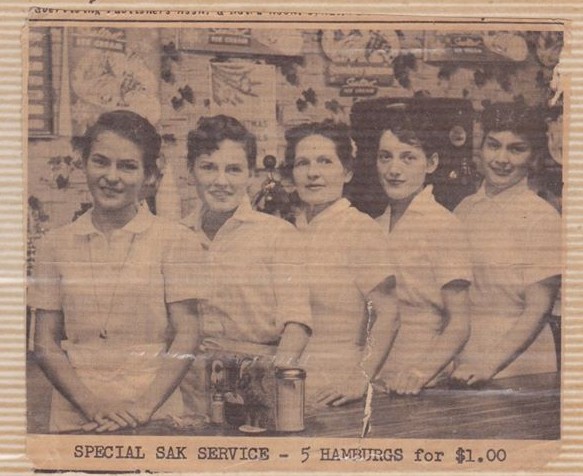
Gladys Seaton, daughter of Britta, also fled a drunken father, only to flee again from the abusive uncle who had taken her in.  The eventual mother to six daughters, she ran a string of diners and coffee shops.  She smoked like a chimney and drank coffee in much the same manner.  Born in 1909, she wrote a letter to her children and grandchildren on the night of the first moon landing in which she marveled at all she had seen.  Outgoing and vivacious, she never let the truth get in the way of a good story.  And in the end, even death couldn’t stop her.  A great believer in the afterlife, for a year or so after her passing she would occasionally appear as a shadow, a scent, or a bit of mischief-making, whether checking on her grand-babies, or teasing and terrifying the daughters she had left behind.

One of whom was Barbara “Bobby” Stressman.  A beautiful, playful woman, she started dating my father when she was fifteen, lost him when she was thirty-eight, and was left to raise four children alone.  She remarried, taking in her mother-in-law, Merle Bell, as well as her second husband’s grandson.  Her children grown, she continues to care for others.  It seems to be her mission.  She told me once that as a very young girl she was taken by friends to a revival meeting downtown, where, with a certainty belying her age, she walked down the aisle and accepted Jesus as her savior.  I’d never heard  that story before, but when I see her now, volunteering at the hospital, or caring for a dying friend, I can’t help but see that same little girl, all by herself, taking the first steps on a journey that would last a lifetime.

From these women came my daughter, who tomorrow turns six.

They are, of course, but one tributary, for flowing north out of Oklahoma and Texas comes another just as beautiful, and certainly just as strong.  But this is the stream I know, for it also flows through me.  And on this day it is good to remember that despite all the obstacles that have stood in its way, it continues to rise anew, cold and clean, bubbling forth in the early morning light.


hallie attitude


A Lot of Things, Very Slowly

17 Apr

OK, a break of sorts.

I have been asked by my old friend Lindsay Porter, who I have known since we were little more than children, and whose blog Chimeragirl2010 (chimeragirl2010.wordpress.com) is wonderful,  to take part in the #mywritingprocess blog tour by answering four questions about how I write.  Being someone for whom I feel a great fondness and admiration, and who will in my memory be forever young, stumbling down a Bucktown street in her cowboy boots and dress, blind to the world because her glasses would spoil the look, it is my honor and privilege to accept.

What are you working on?

A lot of things, very slowly.

A memoir of Arcola Drive, the street I lived on in suburban Detroit from 1968-1973.  It was a street where most everyone was in their late 2os, had a pack of kids, owned their own house, had a car and took a yearly vacation – all on one salary, somehow connected to the auto industry.  I want to find out what’s happened to those families over the last 40 years.

A novel called Limehouse, which follows a young American in London, as he stumbles into the world of Deakin, cranky storyteller, reluctant rogue, inhabitor of ancient pubs.  A man who ages only when he loves, and who, in this way, transcends time.

A comic novella called Lawrenceville, in which a fierce, but bedridden woman sends her hapless husband and son on a journey through the blizzard of the century in an attempt to beat her sister to a long-lost family treasure:  thousands of dollars in rolled quarters buried somewhere in her old home town.

The linchpin to all this, however, is my first short story, Skating the Lake.  It’s my step from memoir to fiction in a format where I can actually see the light at the end of the tunnel.  I can already feel it effecting everything else I’m working on.

And, as always, I’m working on my two blogs, Extra Special Bitter and Playing in the City with Trains,  and the book which I think Playing should become.

How does your work differ from others in its genre?

Well, as you can see, I am all over the place genre wise.  And I don’t really think in terms of being different.  The goal is just to be honest.  That being said, I do have specific goals for each of these projects.

For the Detroit memoir, I’m starting from the memories of a 10 year old boy.  So, beyond the story of a changing world, it will also, by necessity, be a meditation on childhood, memory and community.  In this way it will differ from straight journalism or sociology, which, especially in terms of Detroit, have been done by others far more capable than I.

For Limehouse, the goal is to make it real, to strip away all the whiz-bang fantasy elements to the point where you begin to wonder, is this guy really six hundred years old? Did he really drink with Shakespeare? Or is he just an aging roadie with a wild imagination and a serious alcohol problem?  I like that tension.

Lawrenceville is close to the bone.  These people are family.  They make me laugh, and it’s easy to push that side of them.  But they’re not clowns.  I want them to be real.

Skating the Lake  is also very close.  I just want it to be clean.  No romance, no easy sentiment, no cliches.  Just a moment, polished until it shines.

I’m also big on hope, a quality sorely lacking in much of what I read.  If my work differs from others in its hopefulness, that would make me happy.

Why do you write what you do?

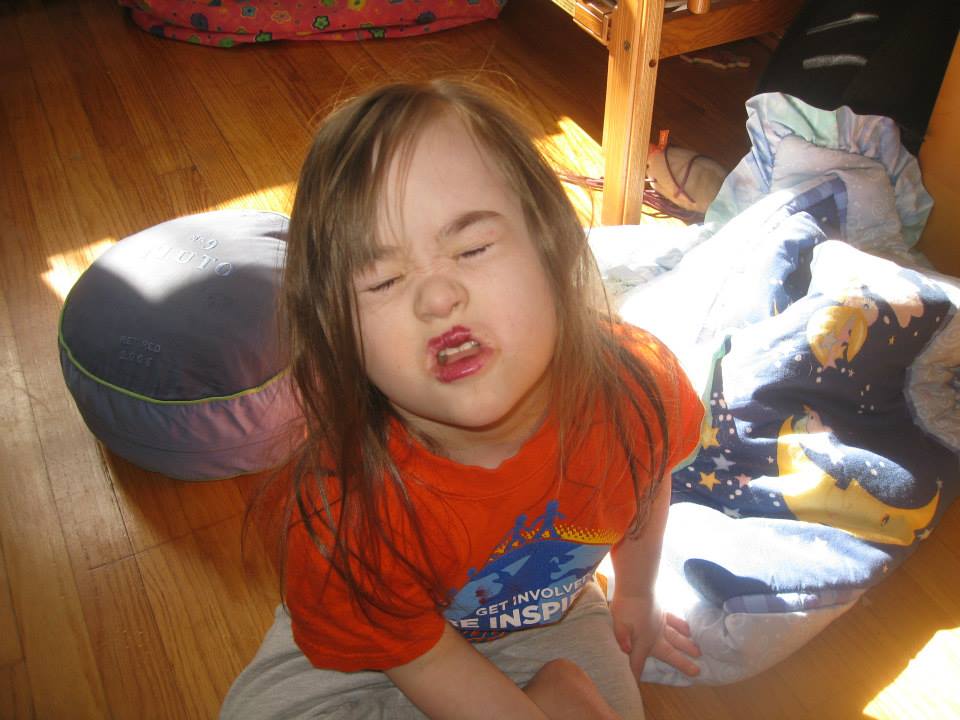
I don’t know.  I always wanted to write, and felt that I could do it, but I had nothing to say.  And then my daughter was born, she had Down Syndrome, and it just ripped me open.  Whatever crap I had spent my life jerry-rigging to keep my emotions tamped down just crumbled, and I could write.  I’ve been catching up with myself ever since.

How does your writing process work?

My challenge is time.  In a perfect world, I would type 1000 words a day first thing in the morning.  It’s absolutely my best time, and it’s usually so enjoyable that I easily exceed a 1000 words.  But between work and kids, this is a rare treat.

Barring that, boring temp jobs can be amazing, and are actually responsible for most of what I do.

Finally, although I’m a Luddite at heart and would love to be  one of those long-hand, pencil & legal pad writers, I’m shamed to admit how useful I find the computer.  The ability to edit in the moment is so satisfying.  I am lost without it.

And now I pass you on to the next leg of the tour.  Kindly take a moment to peek in on my generous fellow blogger and gifted photographer Stephanie Glennon, at Love in the Spaces, where she  live-blogs love lost and found, from blue angels in the backyard to penguins on the equator.

And, as always, thanks for stopping by.

coffee

Winter Rain

5 Mar

Rain

Morning darkness, and the house is at its most gentle, whispering me awake.  Amy has gone upstairs to prepare for her shower while I lie warm beneath the covers, listening for the water, shaken by a dream.

I’m on a ramshackle camping trip, a bunch of us kids unloading gear from our beat up cars and station wagons, carrying it through the grounds of a small carnival to the old houses beyond the fairground.  And somewhere on this journey, it seems, I have made a friend.  She has short dark hair and great big eyes, and although we’ve just met, we’re like puppies in the back seat, leaning into each other, shoulder to shoulder, heads close, laughing, and then going quiet as the miles roll by because nothing has ever felt this good.

Then it begins to rain, and everyone’s a step ahead.

Tents have gone up, a garage floor has been cleared, and while I stand outside, my ratty, unrolled sleeping bag growing heavier by the minute, I realize I have nowhere to go.  She stands at the door of her tent, wringing water from a cloth, and even though she has plenty of room, there’s no way I can ask.  It’s embarrassing just to be standing there.  I move away, into the garage, out of the rain.  But looking around I see all the spaces have been taken.  Busy strangers ignore me as they smooth their pallets across the floor.

And then she’s there, her sleeping bag spread out, and she’s inviting me to join her.

“Really?”

“Yes!” she says, smiling, shaking her head.  I step lightly on the sleeping bag, and we laugh because it’s a little squishy from the rain.

Suddenly my knowledge accelerates, and in a flash, I see everything that’s about to happen . The longing, the intensity, and the unbearable sweetness of this friendship going somewhere I had never thought possible.

And then, for the first time, I remember my kids.  And Amy.  She would know.  And even were I willing to risk that, this young woman clearly has no idea I’m married.  My ring has been lost.  I’d be lying to her as well.

Morning comes.  The rain has stopped.  Friends and neighbors appear.  We share a big box of raisin bran.  It’s the best raisin bran I’ve ever tasted.  Revelatory.  As people pack all around us, I look for her, but she’s nowhere to be found.  Maybe she’s in the car.

The water downshifts to the low hum of the shower, and I have to get up.  Leaving the warmth of the bed for the cool morning air, the anger builds like a cloud in my head.  Tight and sore, my achilles tendons play hell with my balance as I head down the hallway, passing all the stuff we don’t really need.

She took me in out of the rain.

Hand on the rail, I climb the stairs,  squinting and unsure; not yet ready for the light of day.

B&W Rain

Tumbling through Brooklyn

30 Jan

Digital StillCamera

People say time flies when you’re having fun, but that’s bullshit.  Time just flies.                                                                     — Heath Bell

The plan had been to walk Brooklyn, Coney Island to Greenpoint.  An early start with a stop for breakfast in Red Hook, and then a beer in Greenpoint, at that little place on the corner.  In this way I would mark the day.  So come the morning, despite a sore head, a late start, and little desire for a beer at any point during the day, I head out the door.  Coffee in hand, I take my seat on the train, and as the wheels begin to turn the world blurs past.

 I don’t know how to reach him. 

The train takes forever.  The initial pleasure in skipping work fades as the commuters disappear,  leaving only the Brooklyn bound: tired mothers, complacent children, and one very large, angry leprechaun, whose headphones are not taking him to a calmer place.

Even though I see myself in him all the time.

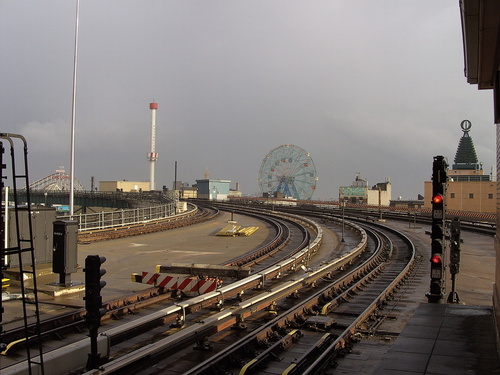
Coney Island is a sad place on a winter’s day.  Bereft of people, the remaining attractions hug the boardwalk like so many dinosaurs, asleep at water’s edge.  Dreamland, Luna, and Steeplechase are long gone, replaced by housing projects, empty lots, and sky.  The few old buildings left along Surf Avenue continue to fade, making room for  an Applebee’s and other improvements reminiscent of a highway rest stop.  A runner passes me on the boardwalk, shirtless in the cold Atlantic wind.  Older guy.  Tough or just crazy?  I vote both, and head inland.

The difficulties in maintaining a friendship, and the inevitable sense of betrayal.  A process of years in my life; minutes in Heath’s.

Once known as the Road of Dreams, Stillwell Avenue is now a bleak strip of auto repair shops and the occasional decrepit house whose demeanor hints at more prosperous times.  A waterside inn perhaps, built along Coney Island Creek when it flowed all the way from Gravesend Bay to Sheepshead, creating an actual island.  Now gray and salt-stained from the spray of traffic, it looks barely inhabited.  I pass by, looking for hints of life, and then continue on, crossing a bridge over the creek’s stilled waters.

How many times has Amy said “Please don’t go away from me”?

Over the next several hours I chip away at the grid, zigzagging through the streets and avenues, progressing at a glacial pace on my journey of discovery.  What do I discover?  Brooklyn’s big.  And Bensonhurst goes on forever.  You heard it here first.

It’s what we do.

Toward the end, hours late for breakfast, legs leaden and feet blistered, having slogged past the auto shops and porn parlors beneath the roar of the BQE, I know I should quit; find a train and head home.  But I don’t.

Not caring.

And then, finally, turning left at the first opportunity, the startling quiet of Red Hook.

Buoyed by familiar landmarks, I head in the right direction, but, strangely, the community fails to materialize.  I see the projects, the parks, the silos, and even the damn Ikea, but the battered little houses where Brooklyn’s more adventurous denizens raise chickens and children in what feels for all the world like some dusty little prairie town are nowhere to be found.  Until suddenly they are, disrupting my sense of geography by appearing at a completely unexpected angle. Having arrived at my destination, I have no idea where I am.  

* * *

He appears as I take off my coat, standing awkwardly to one side, shifting slowly from foot to foot, lost in his own living room.  

“Hey, Heath.”  I toss the words gently, as if they don’t matter, and I wait, not sure if he’s heard me.

And I’m standing at a screen door as my dad tries to coax me into a game of catch.  Embarrassed, because I’m not good at catch, but torn because I know I’m disappointing him,  I cannot bring myself to step through that door.

After a moment, Heath looks up, walks over, and puts his arms around me, awkwardly, as if he’s afraid to complete the hug.

“Happy Birthday, Dad.”

I pull him close.

“Thanks, Heath.”

Looking over his shoulder, I see Amy shake her head.  This was not prompted.

I continue to hold him as long as I can

We feel more than we can show.

And then, without a word, he’s gone.


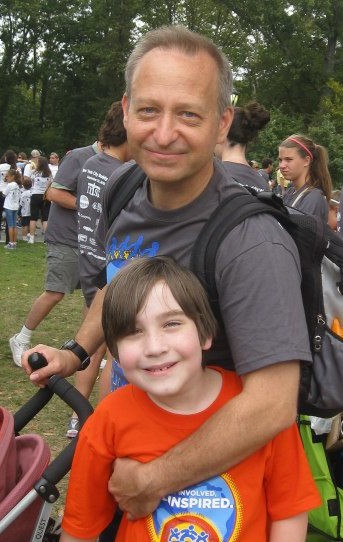
Heath and I Buddy Walk 2012

Photo of Coney Island from http://www.city-data.com 

A Christmas Walk

24 Dec

new-amsterdam-pg-reproductions

“It is required of every man,” the ghost returned, “that the spirit within him should walk abroad among his fellow-men, and travel far and wide…”
― Charles Dickens,  A Christmas Carol

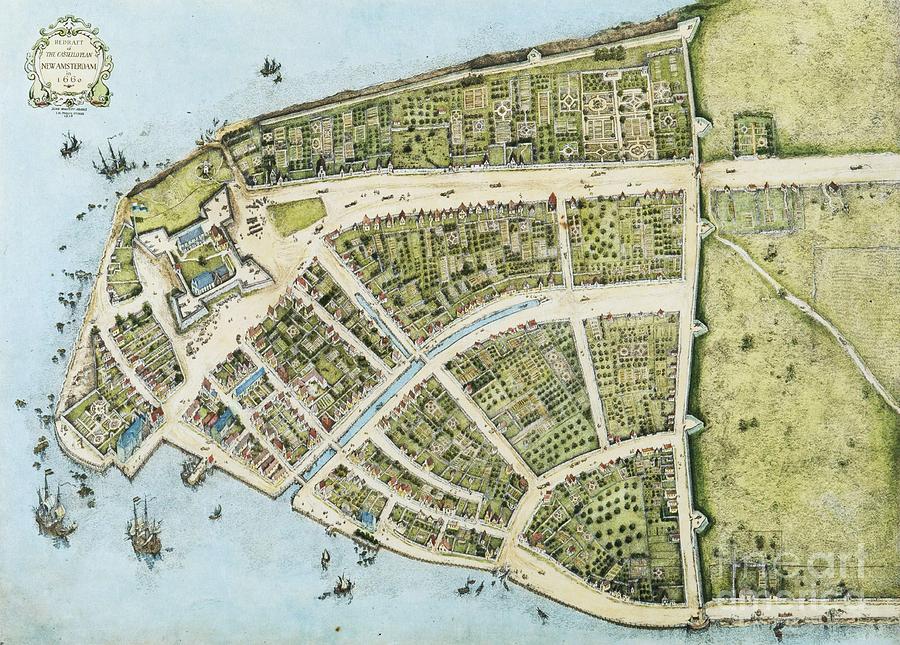
Late in the afternoon, from the 61st floor, I stop to look out  over Manhattan, past the shoulders of the Empire State Building and the slowly rising World Trade Center, down into the late-afternoon gleam of the waters that bathe this archipelago, engulfing the Statue of Liberty and swirling quicksilver past Jersey City and Staten Island, before flowing beneath the Verrazano Bridge, and out into the Atlantic.  Returning to the city itself, my vision hovers over the streets I’ve wandered for the past thirteen years, especially those narrow pathways laid down by the Dutch West India Company at the southern tip of the island over three centuries ago, engulfed now in the buildings and people that followed them, and where, despite everything, late on a quiet afternoon, I can still feel the age of the place, catching the scent of wood smoke on the air before stepping off Pearl Street into a tavern to sip a beer one floor below the room where George Washington said farewell to his officers.

I grew up in Ohio, surrounded by cornfields.  Sometimes, I would wade into them, just for the hell of it, and then, feeling silly, push my way back, scratching through the dusty stalks, to stand for a moment on the side of the road, trying to make something of the experience.  I was looking for a deeper knowledge of the place, something less linear and road based than the world around me. I wanted more dimensions.

Cities are great for this. They just keep giving, every corner you turn, every face you see, every crack in the sidewalk is another dimension, another small accretion in your rapidly growing knowledge of a place. The older the street, the more intricate it’s development, the more there is to be found; more layers of people’s lives, painted one upon the other, and then worn away through the decades, a little bit of each showing through.

My grandmother left  home young, fleeing a small town in Indiana that is now little more than a name on a map; the homes, businesses and the tavern where she would wait for her father, alone in the snow, long faded to lonely roads and empty fields.  My father moved away from the home she created, and I from his, heading east, against the tide, retracing the steps of my immigrant forebears, back to this city they merely passed through as they traveled west in search of new lives.  I roam the streets that must have bewildered them, finding comfort in the knowledge they never had time to acquire.

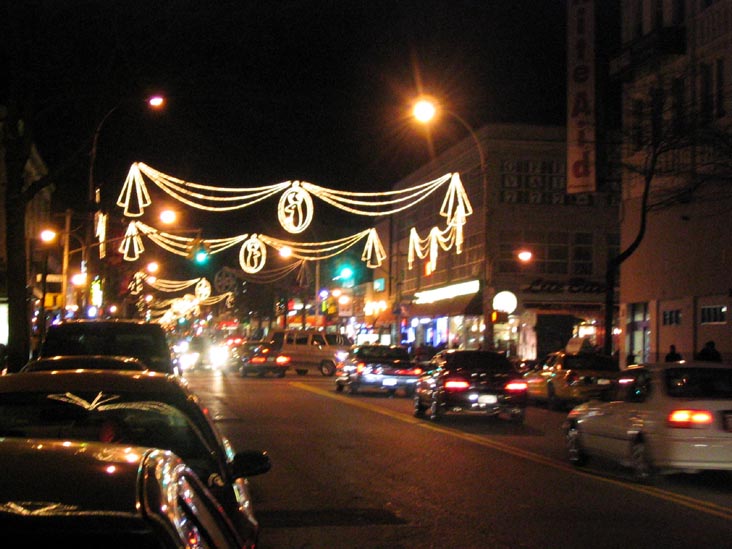
Darkness falling, I cross the river to my quiet neighborhood, and walk its streets in the misty Christmas rain, marveling at how effortlessly I’ve traveled back in time.  Brought up in a swirl of pre-fab housing and six lanes to the shopping center, I live now in a world I thought lost to me.  A place of diners, bakeries, hardware stores and corner taverns, mixed right in with the houses.  A place where at certain times, when the light is right, I expect to see my grandfather among the men in their coveralls walking up the hill at end of the day. And a place where two young boys are playing ball on the sidewalk while their sister and mother watch from the porch, conversing in Spanish, their front door open and their Christmas lights blinking, enjoying the unusual warmth of the season.  A place of comfort, wrapped in a sense of wonder.  A home of sorts.  And a place that I, and so many others, continue to make our own.

Merry Christmas.

01christmas2003steinway

An Actress of Uncommon Stature

15 Nov

medea_diana_rigg_programme_lo_res

The performance begins without prelude.

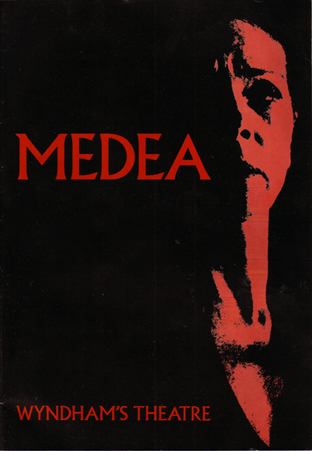
Quietly at first, as we await our breakfast, Hallie catches sight of herself in the mirror and begins to chatter, rapidly but softly, with an intense staccato that slowly builds as, with virtuosic restraint, she works her way, rung by rung, up to the emotional highwire where, finally, she releases all in a swooning crescendo, her arm sweeping the sky as she falls away in a blood curdling “Noooooooooooo!”  A brief pause follows, and then she strains against the straps of her booster chair to check her reflection. Pleased with the effect, and the attention she has drawn, she drops back into her seat, spent from the culminating moments of her five-year old Medea.

But wait! Gathering her energies, she takes a breath and begins again. Initially terse, she launches into a finely wrought internal monologue, a soliloquy of intent.   Passionate, yet controlled, my daughter is rapidly developing into an actress of uncommon stature, her brilliance taking us all by surprise. Certainly, genetics has played a role, but she is now far beyond any gifts inherited from Amy and I, and her talent is all her own.  As a result, in some instinctive fashion, she has gone back, far beyond the modern canon, beyond even Shakespeare, to the primal works of Aeschylus, Sophocles, and Euripides. Not yet regal of bearing, she has, nonetheless, thrown down the gauntlet, challenging the great classical actresses of our time with her staggering combination of intensity, intimacy, and emotional commitment, all expressed with a banana-smeared face and only the rudiments of language.

For Hallie will speak in only the simplest of sentences.  Stubbornly refusing to use three words when one will do, she has expanded this approach into her own unique and rapidly developing oeuvre through which she proves, with each and every performance, that words are merely an adornment to great acting, a crutch for those who lack her artistic rigor and wide open heart.

Suddenly quiet, something shifts, and Hallie enters a different world. The intensity is still there, but it’s combined with a wry sense of amusement, a fatality which, in one so young, is both disturbing and mesmerizing. Could she possibly be…? Yes! She has moved on to Baby John, the youngest Jet in West Side Story! What am I witnessing here? Is she performing in back to back productions? Or has she interpolated the two plays, creating an extraordinary mash-up through which, with her loudly erratic personal rhythm and no sense of pitch whatsoever, she can deconstruct the American musical in a manner that challenges the very boundaries of theatrical convention?

The food arrives and Hallie settles in, glancing across to the mirror and smiling to herself as she begins to eat her scrambled eggs.  Fully aware of the ground she has broken and the ambitious heights she has yet to scale, she is an innovator to her toes, and I fear for the resistance she will meet. Luckily, though, our daughter is fearless, and cares nothing for the critics. Performing only for herself, she alone knows the perfection she pursues.

The rest of us are just lucky to catch a glimpse.

Hallie zoo

Grand Haven, Summer 2013

16 Oct

Grand Haven Postcard

The week has almost passed and I have yet to see a sunset.  I’ve missed them all.  Every single one.  I love my family, but moving all four of us in any specific direction can be a bit like turning an ocean liner.  And as our vacation draws to a close, my patience has worn thin.

“I need to get out.  Just for an hour or so.”

Thankfully, Amy agrees.  As I head for the door, I add, “Hey Heath, do you want to go for a walk on the beach?”  And miraculously, he says yes.

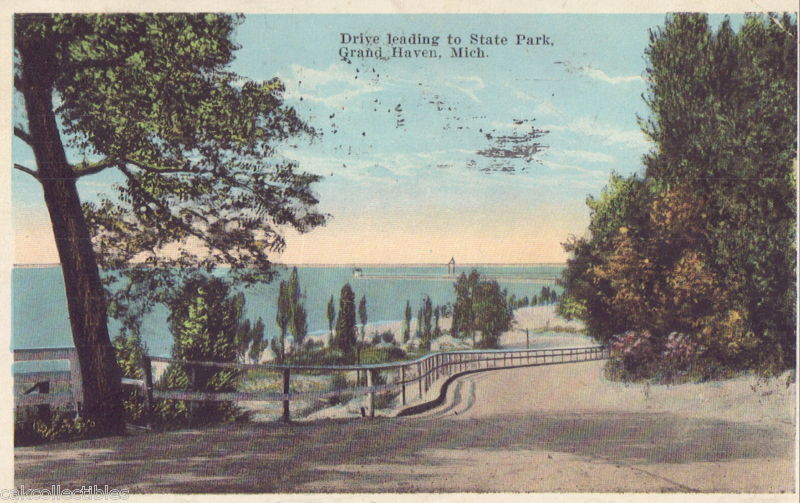
Walking beneath the planks of the porch above, and then climbing the wooden stairs, we leave behind the cool green world of our cozy apartment, tucked down the side of a wooded dune, hidden in the trees which surround The Khardomah, a ramshackle 1870 hunting lodge turned boarding house where we’ve been spending our week.  Heath and I cross the quiet street, and as we head down the gently curving road we pass the original Highland Park cottages; the Loch Hame, the Bonnaire, and others, built in the late nineteenth and early twentieth century, when this land was nothing but forest and sand, and far enough from town that, for a time, it had its own trolley line. 

As we round the bend, Lake Michigan opens before us, a vast, inland ocean whose sudden appearance down these steep, curving roads, never fails to take my breath away.  We look out over the beach, windblown under dense gray clouds, extending north to the town’s most famous landmark, the South Pier, its dark candy red lighthouse temporarily shrouded in the gray primer and netting of a late summer paint job.  The green flag on the lifeguard stand flaps in the breeze, indicating it is safe to swim, but the water is largely empty due to its unseasonable chill.  There had been red flags earlier in the week, not for riptides, as is usually the case, but for hypothermia, and while I did not swim on those days, the water remained cold enough throughout the week to give me a chill that was hard to shake.  

From the top of the hill we make our way down four long flights of stairs, through the sand and dune grass, to the road, where we stop to check for cars, then skitter across and into the parking lot, before kicking off our shoes and stepping into the clean, white sand, cool now this late in the day. The water writhes beneath the overcast sky, a chaotic world of gray and white, and the sunset looks hopeless.  But as we approach the gentle roar of the shoreline, the evening breeze ruffles my son’s hair.

I ask him if he wants to walk down to the pier, and he says “Sure.”  And so we begin.  Walking easily.  Relaxing into each other.

A pair of jet skis scream from far out in the water, their noise, amplified by the open distance, seeming oddly loud to be coming from such small bouncing shadows.  Heath asks what they are, and I tell him that, basically, it’s a couple of guys flying around on floating jet engines, and that on a day like this it must be a pretty rough ride.  He asks why anyone would want to do that, and I tell him I haven’t a clue.

The water is cold against our feet, and Heath is timid at first, skipping awkwardly back up above the waterline every time a wave rushes in.  But slowly, he acclimates, growing bolder and stepping further out into the cold, reveling in his own courage. 

“Oh My God! I can’t believe how wet my pants are getting”

“Well, here.  You need to roll them up.”

I step out into the water and roll his long shorts up above his knees, soaking mine in the process, his laughter contagious.

Heath has Asperger’s Syndrome, and, as a result, so many things have been difficult to share.  His mind is sharp, and his passions are strong, but his palette is limited.  Going outdoors is troubling, exercise is not his friend, and moving him beyond a computer screen is a battle gently waged on a daily basis.  And yet here we are, on a whim, walking the waters of my childhood.  And with every step I can see something inside him ease.

The jet skiers call it a day, their sputtering, high-pitched whine fading into the distance, and as the light begins to retreat, we make our way down the beach, passing three boys who have built a small mound of sand, and are now wrestling about, each one struggling to be king of the hill.

At the pier I show Heath a shortcut up the rocks, and having reached the top, we follow the battered concrete out from the shore, walking beneath the catwalk, passing  the last few tourists as we make our way around the lighthouse and then out toward the foghorn, its deep, melancholy moan, one of my first memories, long ago replaced by a smooth sonic “ping “.  Stepping around its squat red bulk, we come to the end.  Three fisherman, their equipment scattered about, stand before an infinity of water and sky.  A reel hums as a one makes a cast.  His sinker plops as it hits the water and disappears into the darkness. 

As we head back toward shore, the lights are coming on in the cottages, stars among the hills.  Reaching the end, we scramble down to the sand, and Heath heads back to the water, greeting the waves as long lost friends, kicking at them, and delighting in the galaxies that explode off the ends of his feet.  Looking back, I see the pier lights come on, and notice, up above, in the northwest , a small opening in the clouds, it’s edges stained orange and red, the colors beginning to leak across the sky.  Heath continues on, wading up to his knees, smashing at the rushing water. 

Both brooding and vibrant, a vivid rose now dusts  the turbulent blue-gray clouds in every direction.  And then, with no visible movement, the gray is vanquished altogether, and everything above me goes pink.  Neon as far as the eye can see.

“Heath, look!”

Suddenly the lake ignites, the sky illuminating the water like fire on foil, blazes of pink dazzling the crests of the dark blue waves, mirroring the sky to the point that for one dizzying moment, I cannot tell them apart.  

“Heath!” I cried

“Yeah?”

“Are you seeing this?”

“Yes.”

Catching up to him, I wrap my arms around his chest and gently turn him toward the light.    

“This is the most amazing sunset I’ve ever seen.”

But even as I say it, the color begins to recede; the pink melting to orange, the gray closing in.  I hold him for a moment.  We watch, and nothing seems to change.  But when I look away, and then back again, everything is different.

“Heath, have you ever heard the phrase ‘in the moment’?  Do you know what that means?”

“No.” He replies, slipping from my arms and returning the water.

Following, I do my best to explain: the past is gone, the future never arrives, so all we have is now.  How much he takes in, I can’t be sure.  But in the end, it doesn’t really matter.

He’s already there.

Grand Haven pier 


To Play in the Rain

26 Jul

This gift will last forever, This gift will never let you down… 

  –-Glen Hansard

Last night, at bedtime, I could feel the pull of the night air.  I stepped out onto the porch and looked out across the sky. Pale blue with hints of pink, and thin gentle clouds that rose into small,  fairy-tale mountains as I turned to the north.  A breeze on the warm side of cool brushed past the leaves as Hallie followed me out. “Wow,” she said, looking up at the sky, her hair dancing across her face.

Crawling out of the water that morning, rivulets coursing down my body, I rolled onto the catch basin, too tired to lift myself completely out of the pool.  Slowly standing,  breathing hard as drops of water hit the cement, I slowly made my way across the pavement and up the stairs to my t-shirt and towel, every movement intensely felt in my tired muscles, happy now only to walk, after swimming so far.  Is this, perhaps, why we left the oceans behind us? The sheer pleasure of moving in a different way?

The summer’s been lean.  After a couple years of abundant money and too little time, I’ve had to learn again how to live with the opposite.  And for the first time in ages I feel as if I’m having a summer.  My life is made of wind and water, heat and rain.  The sun rises and sets before my eyes, and as the days grow shorter, I am happy to sit on the porch with my little girl and say wow to the sky.

Swimming, biking, and eating ice cream; childhood pleasures that have always cheered me.  But this summer I long to add another.

I want to play in the rain.

I want to dance in puddles with my daughter, chase kayaking leaves with my son, and laugh with my wife as we both get soaked to the skin.  It’s been a while, and I’m sure I’ll look crazy.  But that’s okay.  Embarrassment holds little sway in my life these days, it’s just another enemy of joy.  And joy is what I’m after.  It is, of course, all around me:  in the motion of my body and in the air that I breathe,  in the clouds in the sky and the laugh of a friend, in the attention of my son, the touch of my wife,  and always, always, always in the eyes of my daughter, where the world never fails to inspire, befriend and renew; and where love abides for all she beholds.


It’s Not About Me

31 May

Great wine requires poor soil and difficult weather.

My son is me without the filters.

But he’s also like no one I’ve ever met.

I like people who struggle.

I don’t want to talk about things in the morning.  At least not before coffee.

My friends have begun to get vasectomies.  I’m hoping it’s not a thing.

I like to bring order.

Pulling weeds makes me happy.

I have little patience for chaos.

I tend to blame others.

There is a theory that at some point during our evolution we were actually amphibious, hence the webbing between our thumb and forefingers, our relative hairlessness, and the happiness we find near water.

I regularly dream of the ocean, although it is usually dangerously turbulent.

Bread dough, forced by cold air to rise slowly , creates a richer, more flavorful bread.

I can walk into a bar, and in thirty minutes have a new friend.

Of course, I’ll probably never see them again.

Which brings us back to the whole friend issue.

Wines produced at high altitudes, on cold, barren outcrops, and in the least promising soil, seem to be the ones I like best.

Cold showers always make for a better day.

As does a morning run.

I rarely do either.

I find wine both delicious and fascinating.

I find Amy both delicious and fascinating.

I have no desire to sleep with wine.

If I go from running not at all, to running a lot, I get injured.

If I build up slowly, I’m OK.

It is possible that a lovely mansion built on a rise overlooking a bay will, in a hundred and fifty years, stand empty amidst warehouses, garbage trucks, and sewage treatment facilities, impossible to sell.

Time is fleeting and context is all.

I love the idea of sourdough more than the actual bread.

The process is more interesting than the taste.

My son is smart.

He may be smarter than me.

But he is not as smart as he thinks.

When it comes to people, Hallie may be smarter than us all.

The very word, disability, is limiting.

What does it mean?

I may not be a Bordeaux guy.

I may actually lean Pinot.

But, of course, Italy will always have my heart.

Up north.  In the mountains.

Marriage improves with struggle.

Maybe all things do.

Although it’s a fine line.

I can no longer read by the light of my bedside lamp without holding the book up to my nose.

And then I have to squint.

It is possible to drink wine just about every night.

But not advisable.

It is possible to do sit-ups with your daughter sitting on your belly.

As long as there’s no jumping up and down.

I am a good parent.

I’m a pretty good husband.

I suspect I’ve become a better actor while acting not at all.

My emotions have become more accessible.

In fact, I’m often so tired I cry.

Money is not as important as it seems.

It is, however, addictive.

I’ve made good choices.

I have good instincts.

I am horrible with names.

I’m a creature of routine.

Gifts are tough.

They mean less and less to me.  There’s not that much I want.

And I certainly don’t want to give something meaningless to others.

When I’m ebullient I feel I say too much.

When I’m not I say too little.

Silence is comfortable.  But things seem to build up, like water behind a dam.

Today is my father’s birthday.  He would have been seventy-three.

OK, maybe it is about me.